
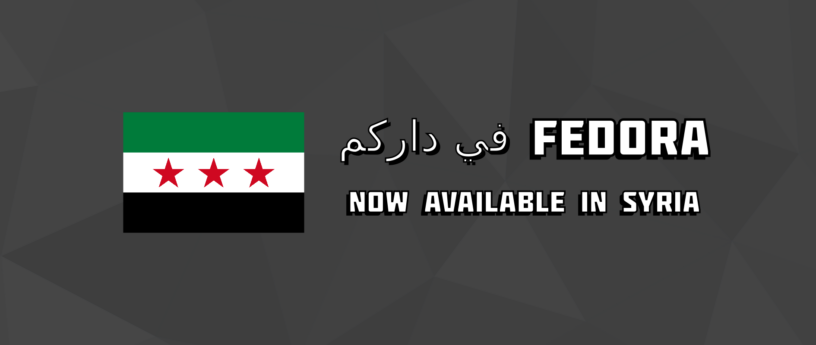



Mrhbaan, Fedora community! 👋 I am happy to share that as of 10 February 2026, Fedora is now available in Syria. Last week, the Fedora Infrastructure Team lifted the IP range block on IP addresses in Syria. This action restores download access to Fedora Linux deliverables, such as ISOs. It also restores access from Syria to Fedora Linux RPM repositories, the Fedora Account System, and Fedora build systems. Users can now access the various applications and services that make up the Fedora Project. This change follows a recent update to the Fedora Export Control Policy. Today, anyone connecting to the public Internet from Syria should once again be able to access Fedora.
This article explains why this is happening now. It also covers the work behind the scenes to make this change happen.
Why Syria, why now?
You might wonder: what happened? Why is this happening now? I cannot answer everything in this post. However, the story begins in December 2024 with the fall of the Assad regime in Syria. A new government took control of the country. This began a new era of foreign policy in Syrian international relations.
Fast-forward to 18 December 2025. The United States signed the National Defense Authorization Act for Fiscal Year 2026 into law. This law repealed the 2019 Caesar Act sanctions. This action removed Syria from the list of OFAC embargoed countries. The U.S. Department of the Treasury maintains this list.
This may seem like a small change. Yet, it is significant for Syrians. Some U.S. Commerce Department regulations remain in place. However, the U.S. Department of the Treasury’s policy change now allows open source software availability in Syria. The Fedora Project updated its stance to welcome Syrians back into the Fedora community. This matches actions taken by other major platforms for open source software, such as Microsoft’s GitHub.
Syria & Fedora, behind the scenes
Opening the firewall to Syria took seconds. However, months of conversations and hidden work occurred behind the scenes to make this happen. The story begins with a ticket. Zaid Ballour (@devzaid) opened Ticket #541 to the Fedora Council on 1 September 2025. This escalated the issue to the Fedora Council. It prompted a closer look at the changing political situation in Syria.
Jef Spaleta and I dug deeper into the issue. We wanted to understand the overall context. The United States repealed the 2019 Caesar Act sanctions in December 2025. This indicated that the Fedora Export Policy Control might be outdated.
During this time, Jef and I spoke with legal experts at Red Hat and IBM. We reviewed the situation in Syria. This review process took time. We had to ensure compliance with all United States federal laws and sanctions. The situation for Fedora differs from other open source communities. Much of our development happens within infrastructure that we control. Additionally, Linux serves as digital infrastructure. This context differs from a random open source library on GitHub.
However, the path forward became clear after the repeal of the 2019 Caesar Act. After several months, we received approval. Fedora is accessible to Syrians once again.
Opening the door to Syria
Some folks may have noticed the Fedora Infrastructure ticket last week. It requested the removal of the firewall block. We also submitted a Fedora Legal Docs Merge Request to change the Fedora Export Control Policy.
We wanted to share this exciting announcement now. It aligns with our commitment to the Fedora Project vision:
“The Fedora Project envisions a world where everyone benefits from free and open source software built by inclusive, welcoming, and open-minded communities.“
We look forward to welcoming Syrians back into the Fedora community and the wider open source community at large. Mrhbaan!


Bilal2453
This is great news! Thank you Justin and for all of the team who worked on this, it really means a lot for us in Syria.
Now I can confidently recommend the distro to more of my friends!
Zaid Ballour
Finally! Thank you to Jef and Justin for your interest in this issue 🙏
SiMus
I wholeheartedly hope that Syria and its people, as well as other nations, won’t be destroyed by geopolitical circumstances—the most precious thing in the world of open source—freedom and open code for all interested in this universal creation of human minds—software.
Many politically driven issues are increasingly polarizing the international scene, and this is precisely why the importance of open source is even more significant and important in these times of unsettling historical winds. As a user of Fedora and open source code, I am most interested in what unites people…not divides them…
🙂
Ed
Which countries does Fedora block right now?
And which ones in the past?
Justin Wheeler
Hi Ed, you can read the Fedora Export Control Policy for the full details.
passerby
(b) to any prohibited destination or to any end user who has been prohibited from participating in U.S. export transactions by any federal agency of the U.S. government
that’s crazy
AsciiWolf
I wonder if, for example, Debian also has a similar policy.
yaman
Welcome back!
muhammad
Turly wonderful news! As a Fedora user from Syria, thank you for your hard work.
Yaser Shahi
This is wonderful news! Hoping for the same freedom for Iran soon.
Bassel
Great news. Thanks to all who took the time and interest to make this happen.
omar
thats amazing i can use fedora when i go back to syria thanks alot fedora team!
ZephyraByte
Thanks a great news!
Syrian should take this opportunity to start adopting the open-source systems and apps in government sector, schools, universities, … etc and leveraging their capabilities. Linux in general and Fedora specifically is a great operating systems to adopt as a driver.
All the best…
Jiyan Baran Kaya
Really? The Syrian government are harming, and attacking small minorities such as Kurds and Druzes, and the new “Dictator” has terroristic acts in his past. I would expect Fedora community would be careful before forgive something. Already when I heard the ban I shocked. Banning a country’s IP because of government’s acts? People would need much more reach Free (as in Freedom) software, when their country is under a dictatorship. I am just broken. I would expect Fedora team would be more meticulous.
Gregory Bartholomew
I think the Fedora Project will just follow the rules as the U.S. government hands them down. If the U.S. says to allow access, they are allowed. If the U.S. government says to block access, they are blocked. The Fedora Project doesn’t have the intelligence resources to determine exactly what happened, why it happened, or who is really responsible.
Odaena
Don’t worry @Gregory, no one will look to such fake and spam posts like what Jiyan is doing. People in Syria are moving on with building their country and they’re not listening to those low voices for persons who got impacted by the fall of Assad’s regime. A lot of “Jiyans” are publishing fake news here and there just because they lost the opportunity to continue stealing all Syria’s resources to make their wealth grow, and they were enjoying killing Syrians over the past decades or at least kept silent for their own benefits.
Syria is moving on
Jiyan Baran Kaya
First of all, it’s shame to blame someone fake, these are my own thoughts; and if I were fake probably I would use (de)social(ized) media instead of Fedora Magazine chat section 🙂 . I am follower of the situations as a person who has connections with minorities. Also; you’re right to someone have an eye on Syria’resources, but it isn’t me. Please see the news from BBC.
1-) At least 12 people passed away: https://www.bbc.com/news/articles/cn5g751pl7lo
2-) Dozens of womens reported kidnapped: https://www.bbc.com/news/articles/cn5g751pl7lo
Plus;
3-) You can read life of today’s unelected man: https://en.wikipedia.org/wiki/Ahmed_al-Sharaa
Plus Plus;
I am not an sabotager, the rebuilding of Syria is good thing, but I don’t feel acts of new government serves this idea.
Sincerely,
Jiyan Baran Kaya
I see, but it’s still mindbending for me, and heart broker to hear that Free software is depends because of the state/country rules. I was thinking it’s accesible even from North Korea. I am what a … 🙂
Thank you for explanation, I am new to this things.